Choosing between Lovable.dev vs Bolt.new has become the central decision for founders, indie hackers, and software engineers seeking rapid product development in 2026. While traditional AI code assistants like Cursor and GitHub Copilot require developers to navigate file trees and write line-by-line syntax, browser-native AI full-stack engines build fully functional web applications directly from natural language prompts.
Both platforms eliminate boilerplate setup by pairing a dynamic front-end preview with automated backend provisioning. However, their underlying execution models, UI fidelity, and deployment architectures target very different workflows.
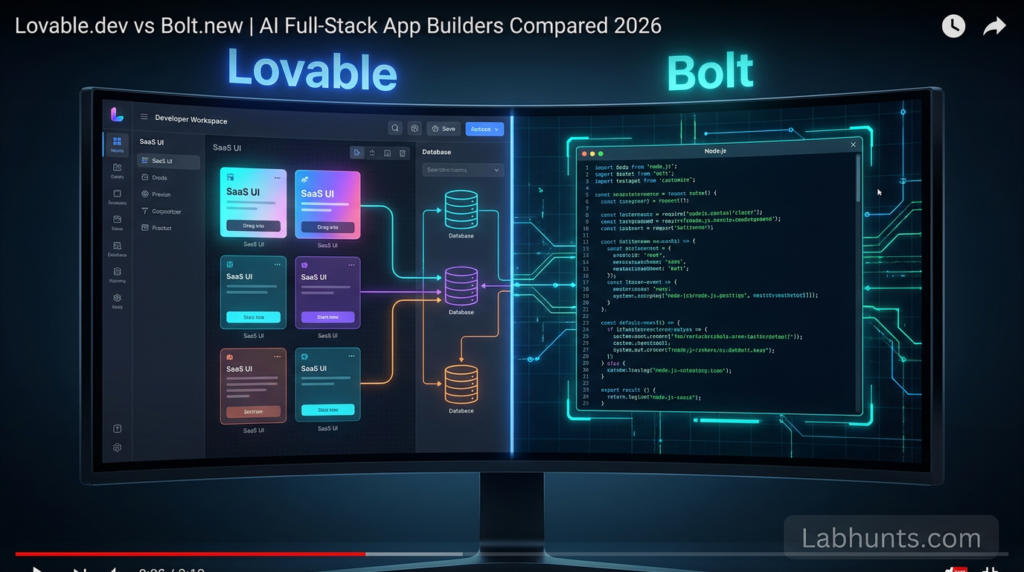
Below is an in-depth comparative benchmark of Lovable.dev vs Bolt.new, analyzing interface precision, database integration, developer ergonomics, and long-term pricing value.
Platform Overviews: Different Visions for AI-Driven Code
What is Lovable.dev?
Lovable.dev focuses heavily on design-first application engineering. Developed to turn complex visual ideas into polished web platforms, it combines automated Tailwind and React components with deep database capabilities. It treats application building as a collaborative dialogue, allowing creators to describe design elements, refine responsive layouts visually, and deploy full-stack software without managing complicated configuration files.
What is Bolt.new?
Bolt.new, engineered by StackBlitz, relies on WebContainers technology to run full Node.js environments directly inside your browser tab. Instead of simulating an app through isolated preview frames, Bolt spins up a live container capable of installing npm packages, running development servers, and executing backend API routes seamlessly.
Feature Breakdown: Lovable.dev vs Bolt.new
| Key Parameter | Lovable.dev | Bolt.new |
| Primary Architectural Engine | Cloud-native generation with dynamic preview | In-browser WebContainers (full Node.js execution) |
| Default Tech Stack | React, Vite, Tailwind CSS, shadcn/ui | React, Next.js, SvelteKit, Vue, Node.js |
| Database & Auth Integration | Deep native Supabase integration | Manual API setup or community Supabase templates |
| UI Polish & Component Styling | Exceptional (Modern, enterprise SaaS design) | Functional and clean, but often requires design prompts |
| GitHub Synchronization | Bi-directional automatic sync & PR workflow | Git repository push & direct ZIP file export |
| Package Management | Curated npm ecosystem | Direct arbitrary npm package installation |
Core Comparison Pillars
1. Front-End Aesthetics and Design Precision
When evaluating Lovable.dev vs Bolt.new on visual delivery, Lovable holds a distinct advantage. It leverages the modern shadcn/ui design system and cohesive Tailwind classes out of the box. Landing pages, administrative dashboards, and user onboarding forms generated by Lovable look production-grade on the very first prompt iteration.
Bolt.new delivers clean interfaces, but default components tend to look generic unless explicitly prompted with detailed UI requirements. However, Bolt excels when you want total freedom over front-end frameworks, supporting SvelteKit, Angular, or Vue without confining you to standard React scaffolds.
2. Backend Logic and Database Provisioning
A web application requires persistent data storage, authentication, and secure row-level security.
- Lovable.dev: Features automated Supabase connectivity. With a single click or prompt command, Lovable creates PostgreSQL tables, sets up user sign-up authentication flows, and connects edge functions without requiring manual schema management.
- Bolt.new: Because it hosts an active Node.js server in the browser, Bolt can run local Express servers, mock backend databases, or execute server-side API routes. While powerful for full-stack prototyping, connecting persistent databases requires adding environment variables and linking third-party cloud backends manually.
3. Error Recovery and Debugging Workflows
Both tools encounter compilation glitches when generating complex logic.
Bolt.new handles errors by displaying live terminal output. When a dependency fails or a build syntax error occurs, its built-in AI debugger analyzes the terminal logs and applies a code patch.
Lovable takes a higher-level approach. If a component crashes, it analyzes browser console messages and regenerates the failing component tree. Non-technical founders will find Lovable’s remediation process easier to follow, while seasoned engineers will appreciate Bolt’s granular terminal access.
Pricing and Token Economics
- Lovable.dev: Operates on monthly subscription tiers based on message/credit quotas. Free tiers allow initial prototyping, while paid plans enable continuous GitHub synchronization, custom domains, and elevated daily AI prompt allowances.
- Bolt.new: Offers a free tier with daily token limits, supported by Pro tiers that provide higher compute tokens and private project storage via StackBlitz. Intensive iterative coding will exhaust tokens quickly on both platforms, making concise prompts essential.
The Final Verdict: Which One Should You Choose?
The decision between Lovable.dev vs Bolt.new comes down to your technical background and product goals:
- Choose Lovable.dev if: You are an entrepreneur, solo founder, or designer building an MVP, SaaS dashboard, or commercial portal that requires high-end UI design, polished micro-interactions, and instant Supabase authentication.
- Choose Bolt.new if: You are an experienced software developer who wants a complete Node.js sandbox in the browser, requires access to diverse frameworks like Next.js or SvelteKit, and prefers low-level control over npm libraries and API routes.
Frequently Asked Questions (FAQs)
Is Lovable.dev better than Bolt.new for non-programmers?
Yes. Lovable.dev provides a smoother visual experience with pre-styled design systems and native database setups, making it easier for non-technical creators to launch functional web apps without debugging terminal logs.
Can you export source code from both Lovable.dev and Bolt.new?
Yes. Both platforms provide full source code ownership. Bolt.new allows instant repository pushes to GitHub or raw ZIP downloads, while Lovable supports bi-directional GitHub integration for continuous deployment.
Does Lovable.dev vs Bolt.new support custom domain deployment?
Both tools allow developers to connect their generated repositories to hosting platforms like Vercel, Netlify, or Cloudflare Pages to attach custom domain names effortlessly.
Internal Linking Suggestions for Labhunts.com
- Compare these autonomous app engines with our guide on Cursor AI vs Windsurf (2026): Which AI Code Editor Wins?
- Explore automated user interface generation in our Gamma AI Review (2026): Is It the Best AI Slide Builder?