Evaluating Gemini vs Perplexity deep research capabilities has become the ultimate benchmark for analysts, academics, journalists, and enterprise teams in 2026. Traditional search engines bury answers behind sponsored links and SEO spam, while standard conversational chatbots frequently hallucinate sources. In response, both Google and Perplexity have engineered dedicated deep research agents designed to browse hundreds of sources, synthesize dense whitepapers, and build comprehensive reports with verified citations.
While Perplexity Pro established the category of AI-first conversational discovery, Google’s advanced Gemini ecosystem leverages massive multimodal context windows and native search graph access.
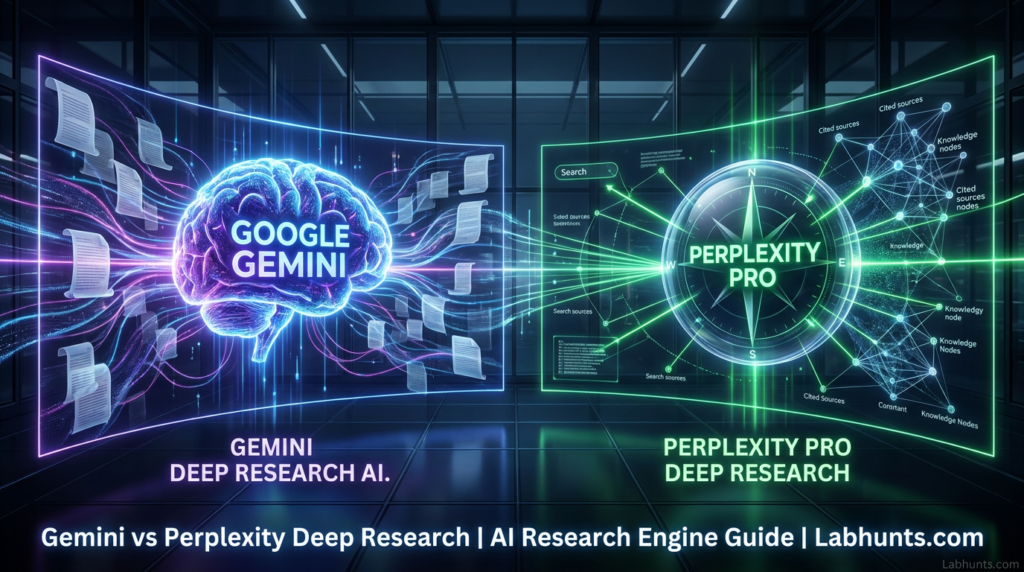
Gemini vs Perplexity (2026): Which AI Search Engine Wins for Deep Research?
Below is an extensive, data-driven comparison of Gemini vs Perplexity deep research, evaluating citation accuracy, academic depth, document synthesis, and pricing value.
Understanding the Platforms: The Evolution of Search
What is Perplexity Pro?
Perplexity Pro is a purpose-built AI answer engine. Rather than relying on a single static model, it operates an intelligent routing layer across premier frontier models—including Claude 3.5 Sonnet, GPT-4o, and specialized Sonar models—paired with real-time web index scraping. Its Deep Research mode conducts recursive, multi-step queries to generate structured academic reports.
What is Google Gemini 2.0?
Google Gemini represents an end-to-end multimodal architecture deeply connected to Google’s real-time knowledge graph and index. Featuring context windows exceeding 1 to 2 million tokens, Gemini processes massive research archives—including entire PDFs, hours of video footage, audio recordings, and raw datasets—in a single prompt workflow.
Benchmark Comparison: Gemini vs Perplexity Deep Research
| Key Parameter | Google Gemini 2.0 | Perplexity Pro (Deep Research) |
| Primary Engine | Native Gemini Multimodal Architecture | Multi-model routing (Claude, GPT, Sonar) |
| Context Window Size | 1M to 2M+ Tokens (Massive local document analysis) | Standard LLM context (~128k–200k tokens per query) |
| Live Web Scraping & Index | Google Knowledge Graph & Real-Time Index | Custom web crawler with real-time domain filtering |
| Citation Granularity | Embedded source links with grounding checks | Inline numbered citations with direct URL popups |
| Multimodal Inputs | Native video, audio, code, and long PDF ingestion | Focused on text, images, and standard PDF uploads |
| Export Capabilities | Direct Google Docs, Gmail, and Sheets integration | Markdown, Collections, and shareable web link pages |
Core Comparison Pillars
1. Source Citation Precision and Hallucination Control
In any serious investigation, citation integrity is paramount:
- Perplexity Pro: Sets the industry benchmark for academic traceability. Every claim features an explicit numeric superscript pointing directly to the exact paragraph or web page sourced. Its UI allows researchers to view, verify, or remove specific domains from the search index if a source appears biased.
- Google Gemini: Utilizes Google’s search grounding layer to verify factual claims. While citation linking has improved dramatically, Gemini occasionally synthesizes high-level overviews without mapping individual claims to explicit footnotes as cleanly as Perplexity.
2. Long-Form Document and Multimodal Research
When evaluating Gemini vs Perplexity deep research on large data ingestion, Gemini’s immense context window gives it an undisputed advantage:
- Gemini’s Context Power: You can upload a 400-page regulatory filing, three competing financial balance sheets, and a 45-minute earnings call audio file simultaneously. Gemini synthesizes the entire corpus without truncation or loss of nuance.
- Perplexity’s Retrieval Mechanism: Relies on Retrieval-Augmented Generation (RAG). While efficient for pulling specific web facts, RAG splits documents into chunks, which can occasionally miss overarching themes or subtle cross-document connections present in large datasets.
3. Agentic Multi-Step Workflow
Perplexity Pro’s Deep Research mode functions as an autonomous research assistant. When prompted with a broad investigative topic, it outlines a research plan, executes dozens of exploratory sub-queries across the live web, cross-checks contradictory facts, and compiles a complete multi-section dossier complete with an executive summary.
Gemini handles complex reasoning with high speed, but structuring structured multi-step exploratory workflows often requires more deliberate prompt engineering by the user.
Pricing and Subscription Economics
- Perplexity Pro: Priced at $20/month. Includes unlimited Pro search queries, access to switch between underlying frontier models, daily credits for extended deep research runs, and API access allowances.
- Google Gemini Advanced: Priced at $19.99/month (Google One AI Premium). Includes access to 2TB of Google Drive cloud storage, full integration across Google Workspace (Docs, Gmail), and highest-priority access to Gemini models.
The Final Verdict: Which Research Engine Wins?
The choice between Gemini vs Perplexity deep research depends on your primary research inputs:
- Choose Perplexity Pro if: You are conducting real-time internet journalism, scientific literature reviews, or competitive market intelligence where transparent inline citations, verified URLs, and flexible model selection are critical.
- Choose Google Gemini if: Your research revolves around massive private datasets, hours of audio/video recordings, multi-hundred-page PDF archives, or deep integration with the Google Workspace ecosystem.
Frequently Asked Questions (FAQs)
Is Perplexity Pro better than Google search for research?
Yes. Perplexity Pro filters out ad-heavy clutter and synthesizes multiple authoritative sources into a direct, citation-backed analytical brief, saving hours of manual link clicking.
Can Google Gemini analyze full PDF documents and research papers?
Yes. Thanks to its multi-million token context window, Gemini can ingest multiple full-length books, financial reports, or scientific papers in a single upload without summarizing through lossy chunking.
Does Perplexity Deep Research verify sources automatically?
Perplexity crawls live web domains and cross-references facts across multiple top-ranking sources, though users can inspect citations to verify source authority directly.
Related AI Benchmarks & Comparisons
- Compare frontier reasoning models in our analysis of DeepSeek-V3 vs Claude 3.5 Sonnet: Open-Weight Frontier Benchmark
- Discover how to automate presentation summaries in our Gamma AI Review: Is It the Best AI Slide Builder?